
Your Australian team, employed
with super paid every payday.
EOR Australia services cover each step from offer to first payslip: an award check, a contract issued by us as your employer of record, the Fair Work Information Statement, tax file number and super fund details, then a pay run with PAYG withholding and a Single Touch Payroll report.
Scope a hire
No agency chain between you and your hire
One US dollar price at every salary level (near AUD 797, ECB, 24 Sep 2026).
The 2026-27 rate (ATO), added to salary until earnings hit the AUD 270,830 base.
Since 1 July 2026, Payday Super gives each contribution this long to reach the fund.
We hold the employment contract. You set the work and the goals.
Managing Australian staff under the Fair Work Act from overseas
Australian employment runs on the National Employment Standards, plus a modern award or agreement for many roles. We apply both, so a manager abroad has answers.
- Probation terms written into the contract
- Four weeks’ annual leave, plus public holidays that differ by state
- 10 days’ personal/carer’s leave, 2 days’ compassionate leave
- Changes to hours or duties, including flexible working requests
- Redundancy pay on the NES scale, 4 to 16 weeks
- Notice, final pay and the last STP report
Notice is where overseas employers most often slip. The NES minimum rises with service, from 1 week in the first year to 4 weeks after 5 years, and staff aged over 45 who have served 2 years or more get an extra week. An employee below the high income threshold of AUD 190,100 (from 1 July 2026), or covered by an award or agreement, can also bring an unfair dismissal claim to the Fair Work Commission.
Events that change a pay run during the year
The Australian financial year runs from 1 July to 30 June, and most payroll changes land on 1 July. On 1 July 2026 the hourly national minimum wage went from AUD 24.95 to AUD 26.44, and award minimums moved up 4.75%. The bottom resident tax rate fell to 15% for 2026-27 and is due to drop to 14% on 1 July 2027. Super now moves with each pay run, so a late payday also means a late contribution.
- PAYG withholding each pay under ATO Schedule 1 coefficients of 17 June 2026
- STP Phase 2 lodged by payday, now carrying qualifying earnings and super
- Super on qualifying earnings up to AUD 270,830 a year
- Payroll tax by state; NSW charges 5.45% over AUD 1.2m
- Workers’ compensation premiums set by each state, e.g. icare in NSW
What do Australian candidates expect on top?
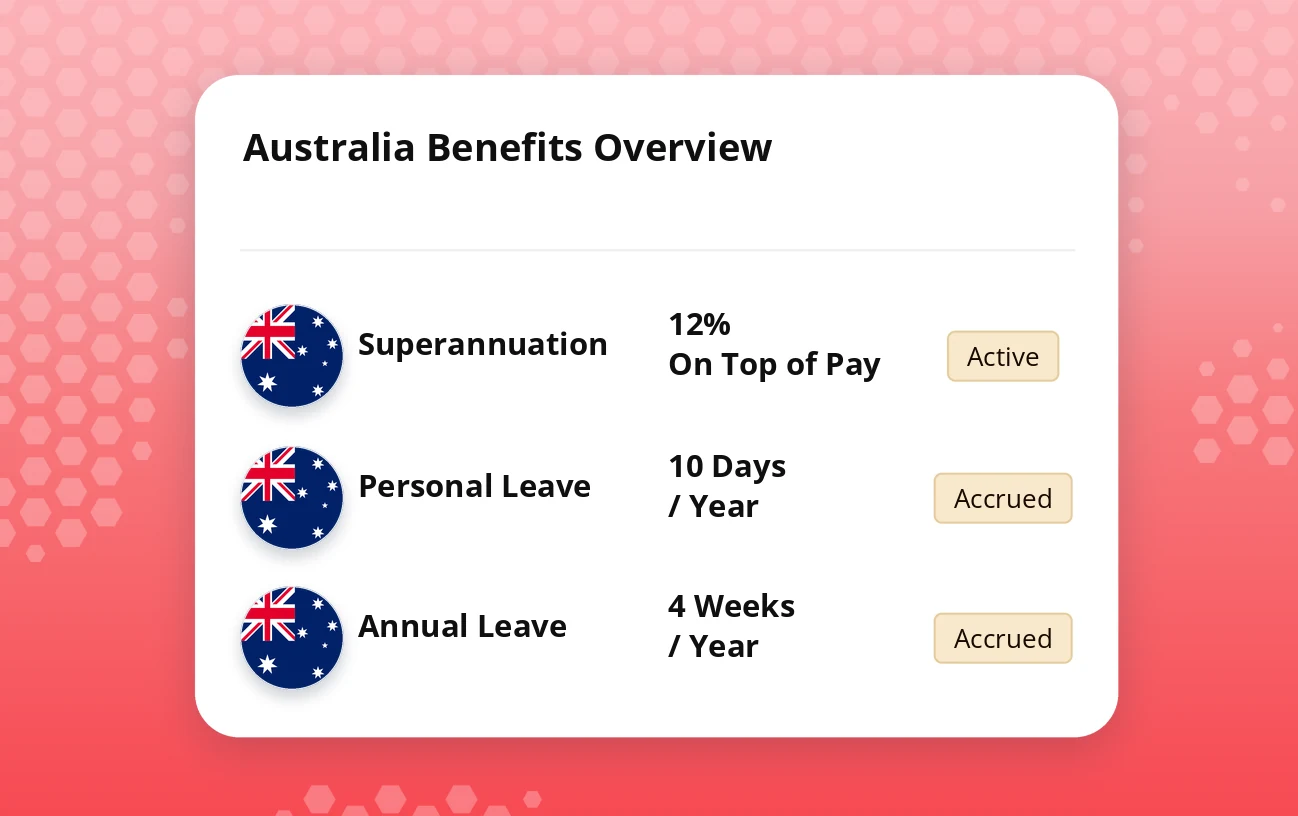
Australian candidates weigh an offer on more than base pay. They look at the super arrangement, private health cover and leave, then at salary packaging. Each benefit has its own treatment: salary-sacrificed super counts towards the AUD 32,500 concessional cap for 2026-27 (ATO), and most non-cash benefits fall under fringe benefits tax, whose year ends on 31 March. We apply the right tax treatment to each one in payroll and STP.
- Salary sacrifice into super
- Private hospital cover
- Employer super above the 12% minimum
- Top-up pay alongside 26 weeks’ Parental Leave Pay
- Extra leave days or annual leave loading
Who does what once the contract starts
The legal employer of your hire is EOR Australia, acting as employer of record. It prepares the contract, hands over the Fair Work Information Statement and holds employer registrations.
You decide the role, the targets and the working week. Your hire reports to your managers like any colleague.
We run each pay cycle: PAYG, super to the fund within the Payday Super window, STP reports and state payroll tax returns.
Modern award coverage decides minimum pay, overtime and penalty rates for many Australian roles, so we settle the award before an offer goes out. Some states, including Queensland and Victoria, license labour hire, and those schemes may reach arrangements like this one, so the work location matters too.
How does our fee compare with others?
We charge a flat from USD 560 for each employee, monthly, covering the contract, payroll, super, STP, state filings and HR support in Australia. Several large platforms list lower “from” prices, so compare what each figure includes before you choose.
| Our serviceAustralia only | Deel | Remote | Papaya | Multiplier | Pebl | RemoFirst | |
|---|---|---|---|---|---|---|---|
| Monthly fee | from USD 560 | USD 599 | USD 699 | From USD 650 | USD 459–559 | $399 | From USD 199 |
| Price published online | ✔ | ✔ | ✔ | ✔ | ✔ | ✔ | ✔ |
| One fixed price, no ‘from’ | ✔ | ✔ | ✔ | ✖ | ✔ | ✔ | ✖ |
| Monthly billing available | ✔ | ✔ | ✔ | ✔ | ✔ | ✔ | ✔ |
| Australian fee shown on its pricing page | ✔ | ✖ | ✖ | ✖ | ✖ | ✖ | ✖ |
| AUD equivalent of the fee shown | ✔ | – | ✔ | – | – | – | – |
| Focused on Australia alone | ✔ | ✖ | ✖ | ✖ | ✖ | ✖ | ✖ |
| Australian cost example online | ✔ | – | – | – | – | – | – |
| Price shows its currency | ✔ | ✔ | ✔ | ✔ | ✔ | ✖ | ✔ |
| Price given in US dollars | ✔ | ✔ | ✔ | ✔ | ✔ | – | ✔ |
Sources: the list price each provider publishes for EOR, read on 25 Sep 2026 from its pricing page; USD unless marked. Pebl, the new name of Velocity Global, prints $399 with no currency named. Multiplier’s plans run USD 459 to 519 a month on annual terms and USD 499 to 559 on monthly terms; compliance add-ons and any implementation fee are extra. A dash (–) marks a point the pricing page does not state. Our starting fee, from USD 560, equals roughly AUD 797 at the ECB reference rate for 24 Sep 2026.
Send us the role, the state and the salary
Tell us the job title, the Australian state, the salary and the start date. We reply with the likely award, the employer on-costs for that state and a draft timeline.