

Employer of Record Australia
Employ someone in Australia without registering a Pty Ltd. As your employer of record, EOR Australia takes on the employer role in law for your new starter. It writes the contract, runs payroll, withholds PAYG tax, pays 12% super each payday and reports every pay run to the ATO through Single Touch Payroll.
Cost a roleClient dashboard
Quick Australian hires, set up correctly from the offer
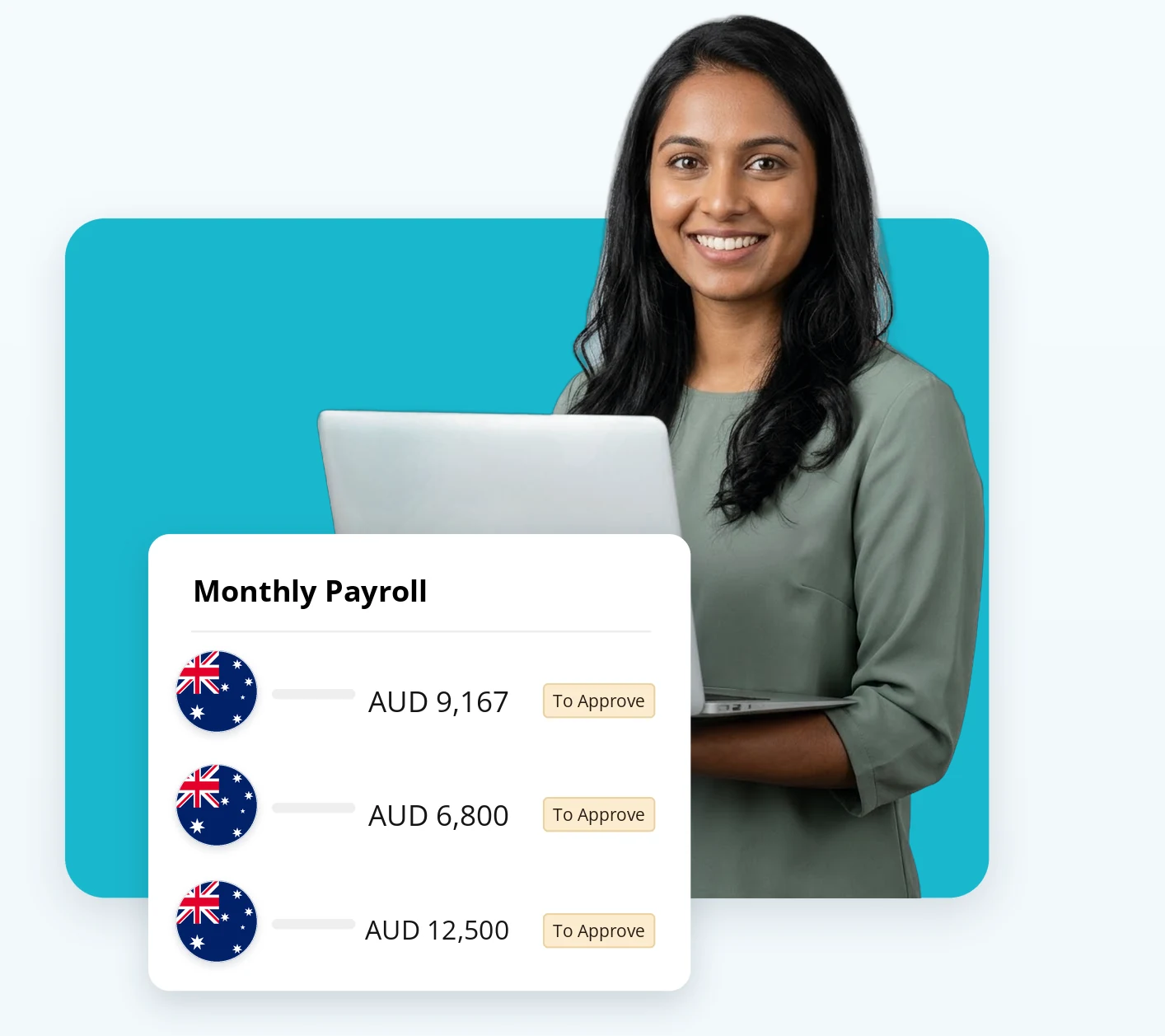
The portal holds the paperwork, and a specialist in Australian employment checks each step behind it. You can see what is done, what is waiting on you and what the next pay run will cost.
- Follow onboarding from the signed offer to the TFN declaration and super fund choice
- Approve each month’s pay run before it goes to STP
- Record pay rises, leave and changes of address as they happen
- Keep payslips and time records ready if the Fair Work Ombudsman asks
How the model works
How does your hire join Australian payroll with no Pty Ltd?
In law, your hire works for us as employer of record, and we are registered for payroll; the daily work is yours to direct. Since 1 July 2026, Payday Super means the 12% super guarantee has to land in the worker’s fund within 7 business days of payday, so super is billed per pay run.
EOR Australia registers for PAYG withholding, reports each payment by payday through STP Phase 2, pays withheld tax to the ATO and lodges the STP finalisation by 14 July. It files NSW payroll tax returns, where they apply, by the 7th for the prior month and, when someone leaves, works out notice and any NES redundancy pay.
Employment costs
What do super and payroll tax add to a salary?
These figures use rates that apply from 1 July 2026, the first day of the 2026-27 financial year, as published by the ATO and Revenue NSW.
Employer costs above salary
For 2026-27 the ATO sets the superannuation guarantee at 12% of qualifying earnings, paid into the employee’s fund on top of salary rather than taken out of it. It stops for the year once earnings reach the maximum contribution base of AUD 270,830. State payroll tax comes next: NSW charges 5.45% on wages above AUD 1.2 million a year (Revenue NSW), and every state sets its own rate and threshold. Workers’ compensation insurance is priced by industry; icare’s 2024-25 NSW rates for professional services ran from 0.213% to 0.520% of wages. In our Sydney example the three add 18.4% to salary.
Figures from a payslip
Australia has no employee social security charge; the payslip shows income tax and the Medicare levy.
- PAYG withholding: the ATO’s Schedule 1 formulas set the tax held back from every salary payment. Resident rates for 2026-27 are nil to AUD 18,200, then 15%, 30%, 37% and 45% above AUD 190,000.
- Medicare levy: 2% of taxable income, collected through the same PAYG withholding. A single employee earning over AUD 105,000 without private hospital cover also pays the Medicare levy surcharge of 1% to 1.5%. Super is never deducted from pay: it is an employer cost.
Worked example
A Sydney hire on AUD 110,000, 2026-27
Yearly cost to you
AUD 130,284
Salary plus AUD 13,200 super, AUD 6,714.40 NSW payroll tax and AUD 369.60 of workers’ comp.
Employee net per year
AUD 84,280
After AUD 23,520 income tax and a AUD 2,200 Medicare levy; AUD 7,021.67 lands each month.
Assumptions: full-time resident claiming the tax-free threshold, no HELP debt, private hospital cover, paid monthly, no leave loading. Payroll tax is charged from the first dollar because we assume the employer’s grouped wages already exceed the NSW threshold; workers’ comp uses an illustrative 0.30%. The EOR fee is not included.
Each month you approve the pay run and receive one invoice for salary, super, payroll tax, insurance and our fee from USD 560 (about AUD 797 using the 24 Sep 2026 ECB rate). We pay wages, report to the ATO through STP on or before payday, get super to the fund within 7 business days and lodge any NSW payroll tax return by the 7th.
Offer signed to first pay run
What happens before your Australian hire starts work?

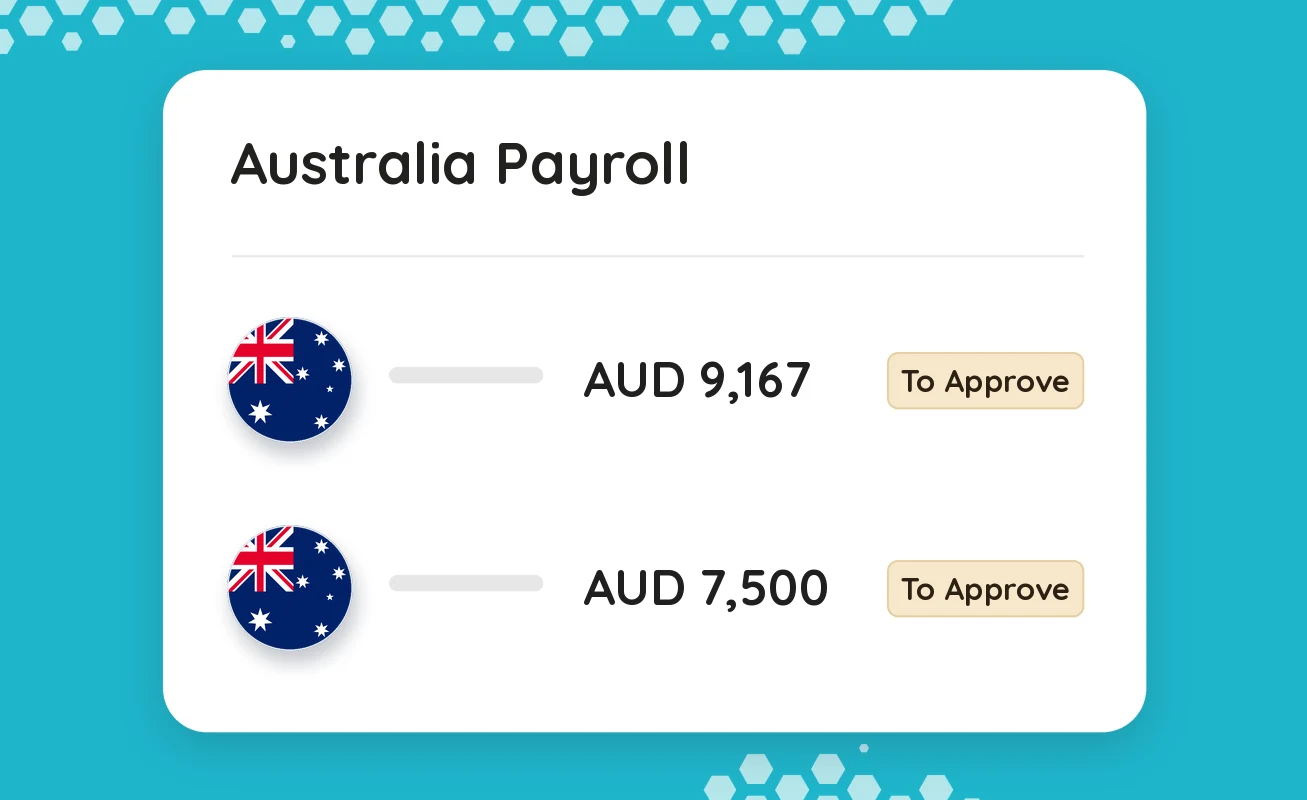
Most of the work sits before day one. After that, one monthly cycle repeats.
At the start, we give your hire the Fair Work Information Statement, plus the fixed-term or casual statement where it applies, and collect a tax file number declaration and a super fund choice. Under Payday Super, a new employee’s first contribution has up to 20 business days to reach the fund.
We draft the contract against the National Employment Standards and whichever modern award covers the role, stating the classification and minimum rate. Fixed-term contracts are limited to two years or two consecutive contracts, with exceptions. A ban on non-competes below AUD 190,100 is only an exposure draft, so restraints are drafted with care.
Each month you approve hours, bonuses and leave. We work out PAYG withholding under Schedule 1 and report each payment to the ATO through STP Phase 2 on or before payday; from 1 July 2026 those reports also carry qualifying earnings and super liability. Super goes out inside the 7-business-day window, withheld tax is paid to the ATO, NSW payroll tax goes on the monthly return, and an STP finalisation declaration closes the year by 14 July.
People who are not citizens or permanent residents need a visa with work rights. The main employer-sponsored route is the Skills in Demand visa (subclass 482), which replaced the Temporary Skill Shortage visa on 7 December 2024 and allows a stay of up to four years.
Sponsorship rules for a worker placed with another business are strict, so we confirm the visa route, and whether sponsorship is possible at all, before an offer goes out.
The service suits office and remote roles in software, finance, sales and consulting. Where a modern award or the host’s enterprise agreement covers the work, pay and penalty rates can change; a Fair Work Commission Same Job Same Pay order can require a supplied worker to be paid at the host’s agreement rate.
Getting started
Your start date follows the offer, not ASIC
A Pty Ltd needs director IDs and ASIC registration, then an ABN, PAYG, payroll tax, workers’ comp and a default super fund. With us, the first step is the offer letter.
Share the job details
Salary, start date, state and duties: enough to check award coverage and the total cost.
Read a costed quote
Super, payroll tax for that state and insurance are shown before any offer, with our fee on top.
Contract prepared for signature
We write the contract against the NES and any award and send it to your hire to sign.
Tax and super details
Your hire completes a TFN declaration and chooses a super fund or takes the default.
Payroll set for STP
The first pay run is scheduled, with super timed to meet the Payday Super deadline.
Day one and onwards
You manage the work; we run payroll, leave balances and records.

Who looks after your account
One person answers your questions about Australian payroll
Your contact works on Australian payroll every day and knows how awards, super and state taxes apply to your people. You email one person, not a ticket queue.
Message usPty Ltd or EOR?
Should you register a Pty Ltd or employ through EOR Australia?
There are two routes to an Australian employee: register your own proprietary company (Pty Ltd) with ASIC and run payroll yourself, or let us employ the person as employer of record while you manage the work.
Registering a proprietary company
Every director needs a director ID, the company needs a physical registered office in Australia, and online registration through the Business Registration Service takes about 15 minutes, with ASIC confirmation usually within 2 business days.
ASIC’s fees are indexed each year; check them on its site. Larger costs follow: accounting, STP-enabled payroll software, workers’ comp cover and state payroll tax once wages pass the threshold. Over several years, a company can cost less per head than our fee.
- ABN, TFN and PAYG withholding set-up
- Payday reporting to the ATO under STP Phase 2
- Super paid within 7 business days of payday
- State payroll tax returns and a workers’ comp policy
- An annual review with ASIC and a yearly solvency resolution
Hiring with EOR Australia
We employ your hire in law as employer of record, hold the ATO and state registrations and run payroll; you direct the daily work. You pay the employment costs, from USD 560 a month per employee and, in most cases, a one-off set-up fee. Should you set up a Pty Ltd later, the employee can transfer to it under a new contract.
- No director ID or office address
- Contract written against the NES and awards
- PAYG, STP and super handled each payday
- Payroll tax and workers’ comp arranged
- Notice and redundancy pay worked out
EOR or a Pty Ltd: which fits?
Choose EOR when
You are hiring one person or a small group, testing demand, or want someone working before a company could be registered and its payroll set up. It also suits a remote hire in a state where you have no presence. If the role is in Queensland, Victoria, South Australia or the ACT, ask us about labour hire licensing first.
Choose your own Pty Ltd when
You plan a sizeable team, will sign contracts with Australian customers, need to hold assets locally, or want to sponsor visa workers directly as a standard business sponsor. At that scale a company’s fixed costs spread across many staff, and we can help move employees across.
Not sure which fits your headcount? Send us your hiring plan and we will compare both routes, with costs for the state your hire lives in.
Employee entitlements
What do the National Employment Standards guarantee?
The Fair Work Act 2009 sets the National Employment Standards, a floor no contract can go below, and modern awards add to it for covered roles. The Fair Work Ombudsman enforces them; the Fair Work Commission sets award rates.
Annual leave
Permanent staff build up 4 weeks of paid annual leave per year of service: 20 working days for a five-day full-timer. Casuals instead earn a 25% loading. A 17.5% leave loading applies only if an award or contract says so.
Public holidays
NSW declared 13 public holidays in 2026, including Easter Saturday and Sunday and extra Mondays for Anzac Day (27 April) and Boxing Day (28 December). Other states and territories set their own lists.
Sick pay
A full-timer is owed 10 days of paid personal/carer’s leave for each year worked, with part-timers accruing in proportion. The days can be used when the employee is ill or injured, or when someone in their immediate family or household is unwell or has an emergency and needs care. Separately, all staff, casuals too, may take unpaid carer’s leave of 2 days for each occasion, and permanent staff get 2 days’ paid compassionate leave per occasion. Casuals receive no paid personal leave; their 25% loading stands in for it.
Parental Leave Pay
From 1 July 2026 the government’s Paid Parental Leave scheme pays up to 26 weeks at the national minimum wage rate, usually through the employer’s payroll, with 4 weeks reserved for each parent. The ATO adds 12% super on it.
Parental leave
After 12 months’ service, each parent can take up to 12 months’ unpaid parental leave and return to their job, with the right to request a further 12 months.
Family violence
Every employee, casuals included, can use 10 days of paid family and domestic violence leave in each 12 months. Long service leave comes from state law; the NSW Act grants 8.67 weeks once someone completes 10 years’ continuous service.
How we keep entitlements on track
Leave balances accrue in payroll each pay run and appear in the portal. Award classifications and rates are reviewed when the Fair Work Commission’s annual wage review takes effect on 1 July (4.75% for awards in 2026), and long service leave is tracked under the law of the state where your employee works.
Our services
What the fee covers
As your Employer of Record Australia, we charge from USD 560 monthly per employee for employment, payroll, tax and super, HR support and benefits administration. Salary, super and payroll tax are billed apart; a set-up fee usually applies.
All services ›Employing without an Australian company
ATO and state registrations sit with us as employer of record, and we sign the contract, so you can hire ahead of, or in place of, a Pty Ltd.
Payroll, PAYG and super
Monthly pay runs with Schedule 1 withholding, STP Phase 2 reporting, Payday Super on time and payslips your employee can read.
HR and Fair Work support
Contracts checked against the NES and the relevant award, leave tracked, and help with performance issues, resignations, notice and redundancy under the Fair Work Act.
Benefits and salary packaging
Salary sacrifice into super, private health cover and other benefits set up through payroll, with fringe benefits tax considered first.

Employing in Australia
Plain answers aboutsuperannuation|in Australia
Our Employing in Australia hub explains the rules behind each of these, from Payday Super deadlines to the AUD 190,100 unfair dismissal threshold, with links to the ATO, the Fair Work Ombudsman and state regulators.
Go to Employing in Australia ›Our approach
How do we work with your Australian team?
Employer of Record Australia gives you one named contact and a flat monthly fee. Before any offer we tell you which award applies, what super, payroll tax and insurance add in your employee's state, and whether labour hire licensing is relevant there.
About usAsked before a hire
Yes. On paper your hire works for us as employer of record; we run payroll and hold the ATO registrations, so you need no ABN, ACN or director ID of your own. You direct the work and approve each pay run.
Once the offer is accepted, timing depends mostly on your hire: signing the contract, completing a TFN declaration, choosing a super fund and, for people who are not citizens or permanent residents, holding a visa with work rights. Your own Pty Ltd would first need director IDs, ASIC registration, an ABN, PAYG registration, state payroll tax and workers' comp.
It can. Labour hire providers need a licence in Queensland, Victoria, South Australia and the ACT. An arrangement where one business employs and pays a worker who works for another may fall within those laws. Tell us the state first and we will explain what applies before you commit.
You pay the employment costs, from USD 560 monthly for each employee (roughly AUD 797 on 24 Sep 2026, ECB) and usually a one-off set-up fee, which your quote confirms. For a Sydney employee on AUD 110,000 in 2026-27, salary, super, payroll tax and workers' comp come to AUD 130,284 a year before our fees. If you also hire outside Australia, mention it on the call.
Which state will your hire be in?
Payroll tax, workers' comp, long service leave and public holidays change from one Australian state or territory to the next.
Tell us where your hire will live and we will price the role under that state's rules.
Get a state quote
Next step
Let's plan your first Australian starter
Book a short call and we will walk through award coverage, super and state costs for your role.
Not taking new enquiries just now
Our Australia team is at capacity at the moment, so we have paused new enquiries. Please check back soon.